Discovering how to generate product review articles with AI offers an efficient and innovative approach to creating comprehensive content that engages readers and provides valuable insights. Automating this process not only saves time but also ensures consistency and depth in reviews, making it an essential tool for content creators and marketers alike.
This guide explores the step-by-step process, from researching products and structuring reviews to generating detailed content and enhancing readability, all through the effective use of AI tools tailored for WordPress and online publishing.
Introduction to AI-generated Product Review Articles

In the rapidly evolving landscape of digital marketing and content creation, automating the production of product review articles has become increasingly vital for businesses seeking efficiency and scalability. AI-powered tools enable content creators to generate detailed, unbiased, and consistent reviews at a fraction of the time traditionally required. This technological advancement offers a strategic advantage, allowing brands to keep their audiences informed with fresh and comprehensive insights into a wide array of products.
The significance of automating product review content lies in its ability to enhance productivity while maintaining high-quality standards. Automated review generation not only reduces human workload but also ensures uniformity in tone and structure, making it easier to manage large-scale content campaigns. Additionally, AI-driven tools are capable of analyzing vast amounts of data from multiple sources, including customer feedback, specifications, and market trends, to craft reviews that are both accurate and relevant.
Benefits of Using AI Tools for Generating Comprehensive Reviews
Implementing AI tools in the review writing process offers numerous advantages that contribute to more effective content marketing strategies. Firstly, AI systems can rapidly synthesize data from various sources, providing in-depth analysis that covers all critical aspects of a product, such as features, performance, durability, and user satisfaction. This ensures that reviews are thorough and informative, helping consumers make well-informed purchasing decisions.
Secondly, AI-generated reviews promote consistency in style and structure, which is particularly beneficial for brands managing multiple products across different categories. This uniformity enhances brand identity and credibility. Moreover, AI tools can be programmed to adapt tone and language to suit different target audiences, whether formal, friendly, or technical, ensuring the content resonates with specific user segments.
Furthermore, automation accelerates the content creation process, enabling businesses to publish reviews promptly in response to market developments or product launches. This agility is crucial in competitive markets where timely information can influence consumer choices. AI can also facilitate personalization by tailoring reviews based on user preferences or browsing history, further increasing engagement and conversion rates.
General Process of Developing Product Review Articles with AI
The development of product review articles using AI involves a structured approach that combines data aggregation, analysis, and natural language generation. Initially, relevant data is collected from credible sources such as manufacturer specifications, customer feedback, expert opinions, and competitor analyses. This data forms the foundation for creating a comprehensive review.
Next, AI models process and analyze the collected data to identify key features, performance metrics, pros and cons, and unique selling points. This step often utilizes machine learning algorithms trained on large datasets of existing reviews to understand patterns and generate meaningful insights. The AI then synthesizes this information into a coherent draft, maintaining clarity and objectivity.
Finally, the generated content is reviewed and refined, either manually or through additional AI tools that optimize readability and tone. Some systems incorporate feedback loops, learning from human edits to improve future outputs. The result is a well-structured, informative product review article ready for publication, which can be scaled efficiently across multiple product lines and platforms.
Researching and Selecting Products for Review
Choosing the right products for review is a fundamental step in creating compelling and relevant AI-generated product review articles. Effective research ensures that the products selected align with current market trends, consumer interests, and the target audience’s needs. By systematically analyzing product popularity and defining clear selection criteria, content creators can produce reviews that resonate with readers and enhance credibility.
This process involves identifying trending or popular products, evaluating their features, and considering the preferences of the intended audience. A strategic approach to product selection not only streamlines content creation but also maximizes engagement and trustworthiness.
Identifying Trending or Popular Products Suitable for Review
To produce relevant reviews, it is essential to focus on products gaining significant attention in the market. Various methods can help identify trending or popular items:
- Social Media Monitoring: Platforms like Instagram, TikTok, and Twitter often highlight trending gadgets, fashion items, and tech devices through viral posts and influencer endorsements.
- Marketplaces and E-commerce Platforms: Analyzing bestseller lists on Amazon, eBay, or Alibaba provides insights into products currently in high demand.
- Industry Reports and Market Trends: Consulting reports from organizations like Statista or Nielsen can reveal fast-growing product categories.
- Search Trends and s: Tools like Google Trends, SEMrush, or Ahrefs help identify search volume spikes for specific products or categories.
Regularly updating research methods ensures that reviews stay current and aligned with market shifts, which is crucial in maintaining relevance and reader interest.
Criteria for Choosing Products for Review
Selecting the right products requires an organized evaluation process based on specific criteria. These criteria help assess whether a product is suitable for review and resonate with the target audience:
- Product Features and Uniqueness: Determine if the product offers innovative features or solves common problems effectively.
- Market Demand and Popularity: Verify that the product is trending or has a steady consumer interest.
- Target Audience Compatibility: Ensure the product aligns with the preferences, needs, and purchasing power of the intended readers.
- Availability and Accessibility: Confirm that the product is readily available for purchase or review purposes.
- Price Point and Value: Consider whether the product provides value for money relative to its features and competitors.
Applying these criteria systematically helps in curating a list of products that not only attract viewers but also provide meaningful insights in reviews, enhancing credibility and usefulness.
Product Specification Comparison Table Template
Creating a structured comparison table simplifies the evaluation process, allowing for quick identification of product strengths and weaknesses. Here is a versatile template designed to compare up to four products across key specifications:
Specification Product 1 Product 2 Product 3 Product 4 Price Features Performance Customer Ratings
This table format facilitates side-by-side comparison, making it easier to communicate differences and advantages clearly within the review article.
Generating Content with AI
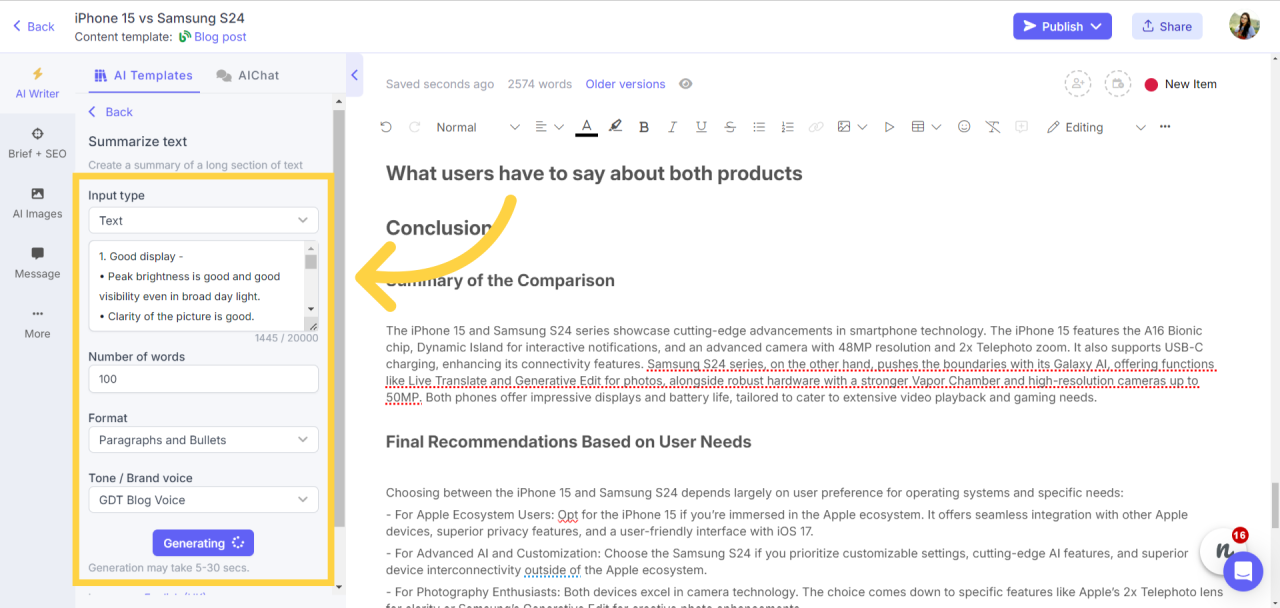
Leveraging AI to produce comprehensive and engaging product review articles enhances efficiency and consistency in content creation. Properly instructing the AI allows for detailed descriptions, thorough analysis of product features, and organized presentation of user experiences, ultimately resulting in well-structured and credible reviews that resonate with readers.
In this section, we explore practical techniques for utilizing AI effectively to generate rich content, including how to request detailed feature descriptions, comprehensive lists of advantages and disadvantages, and well-organized testimonials and user insights.
Producing Detailed Descriptions of Product Features
Providing clear and specific prompts to the AI ensures the generation of detailed, accurate, and engaging descriptions of product features. When requesting feature descriptions, it is beneficial to specify aspects such as functionality, design, material quality, compatibility, and usability. For instance, instructing the AI with prompts like “Describe in detail the key features of [product], including its design, functionalities, and user interface” guides it to produce in-depth content.
To enhance the quality of descriptions, incorporate context about the product’s target audience or intended use, which helps the AI tailor its responses appropriately. For example, “Provide a detailed description of the ergonomic features of [product] suitable for professional users who spend long hours at their desks.” This approach ensures the generated content aligns with specific consumer needs and enhances the review’s authenticity.
Requesting Comprehensive Lists of Advantages and Disadvantages
Listing pros and cons is vital for balanced product reviews. When engaging the AI for this purpose, frame your requests to emphasize thoroughness and clarity. For example, you might say, “Generate a comprehensive list of advantages of [product], considering aspects like performance, cost-effectiveness, and user experience, followed by a detailed list of disadvantages.”
Encouraging the AI to elaborate on each point increases the depth of analysis. Using phrases such as “Explain each advantage and disadvantage with specific examples or scenarios” helps in creating nuanced content. Additionally, requesting the AI to categorize advantages and disadvantages—for instance, into technical, aesthetic, or functional aspects—can aid in structuring the review more effectively.
Organizing User Experience Insights and Testimonials
Incorporating authentic user feedback enriches reviews by providing real-world perspectives. To organize these insights efficiently, request the AI to present user testimonials using bullet points or blockquotes, emphasizing clarity and readability. For example, instruct: “Summarize user experiences with [product], highlighting key points in bullet points for easy reading,” or “Present user testimonials in blockquotes to emphasize authentic feedback.”
When collecting insights, specify the focus areas such as ease of use, durability, customer service, or value for money. This targeted approach ensures that the testimonials address relevant aspects of the product. Employing bullet points allows for quick scanning of user highlights, while blockquotes lend a professional, authentic feel to the content. It is also effective to synthesize multiple user reviews into thematic summaries, capturing common praises and concerns to provide a balanced overview.
Enhancing Readability and Engagement
Creating compelling and easily digestible product review articles is essential for capturing the reader’s interest and maintaining their engagement throughout the content. When utilizing AI-generated content, incorporating strategies that improve readability and foster a connection with the audience can significantly elevate the quality of the reviews. These methods not only make the information more accessible but also encourage readers to trust and act upon your recommendations.Incorporating descriptive subheadings and engaging language transforms a straightforward review into a lively and reader-friendly article.
Using clear, concise, and appealing headings guides readers through the content logically and intuitively, making it easier to locate specific information. Additionally, employing lively language, such as vivid adjectives and active voice, helps to convey enthusiasm and authenticity, which can persuade readers and evoke their interest.Adding illustrative examples, detailed comparisons, or analogy explanations further enriches the content by providing context and clarity.
Real-world examples, like comparing the battery life of two smartphones or contrasting the durability of different outdoor gear, help readers relate to the information and make more informed decisions. Analogies—such as likening a laptop’s performance to a well-oiled machine—simplify complex technical details and make the review more understandable.Creating visually appealing HTML tables is a highly effective way to summarize key points, features, or specifications in a structured manner.
Well-designed tables enable readers to quickly scan and compare products without sifting through lengthy paragraphs. For example, a comparison table listing key specifications like price, battery life, weight, and customer ratings allows for easy side-by-side evaluation, making the decision-making process smoother and more efficient.By thoughtfully integrating descriptive subheadings, engaging language, illustrative examples, and clear visual summaries, AI-generated product reviews can be significantly more engaging, trustworthy, and reader-friendly, ultimately enhancing their overall impact and effectiveness.
Finalizing and Formatting the Article

Producing a high-quality product review article using AI involves meticulous editing and thoughtful formatting to ensure clarity, coherence, and reader engagement. After generating the initial content with AI, the finalization process is crucial to transform raw output into a polished, professional piece that effectively communicates your message and appeals to your audience. Proper formatting not only enhances visual appeal but also improves readability and navigability, making it easier for readers to find key information and understand your review comprehensively.Ensuring that the AI-generated content is properly refined and structured is essential for maintaining credibility and providing value.
This step involves editing for clarity and logical flow, embedding HTML tags to organize information, and employing formatting techniques such as bullet points, headings, and summaries. These practices contribute to a well-organized article that guides the reader seamlessly through your review, highlights important features, and presents data in an accessible manner.
Editing AI-Generated Content for Clarity and Coherence
Effective editing begins with a detailed review of the AI-produced text to identify and correct any inconsistencies, ambiguities, or redundancies. It is advisable to break down lengthy sentences, replace vague language with precise terminology, and ensure that the tone remains consistent throughout the article. Reading the content aloud can help detect awkward phrasing and unnatural transitions, allowing for smoother flow.Pay close attention to the logical progression of ideas, verifying that each paragraph supports the main points logically.
Rearranging sections for better flow, removing irrelevant information, and clarifying technical terms enhance overall readability. Additionally, checking for grammatical and spelling errors is fundamental to uphold professionalism and credibility.
Embedding HTML Tags for Tables and Structured Content
HTML tags are vital for organizing complex data and presenting structured content clearly. When including specifications, comparison tables, or feature lists, use the
| (table header), and | (table data) tags to create clean, easily navigable tables. For example, a product comparison table might display features like price, dimensions, weight, and user ratings in a grid format, enabling quick visual comparison.Structured content can also be enhanced using semantic HTML tags such as
|
|---|